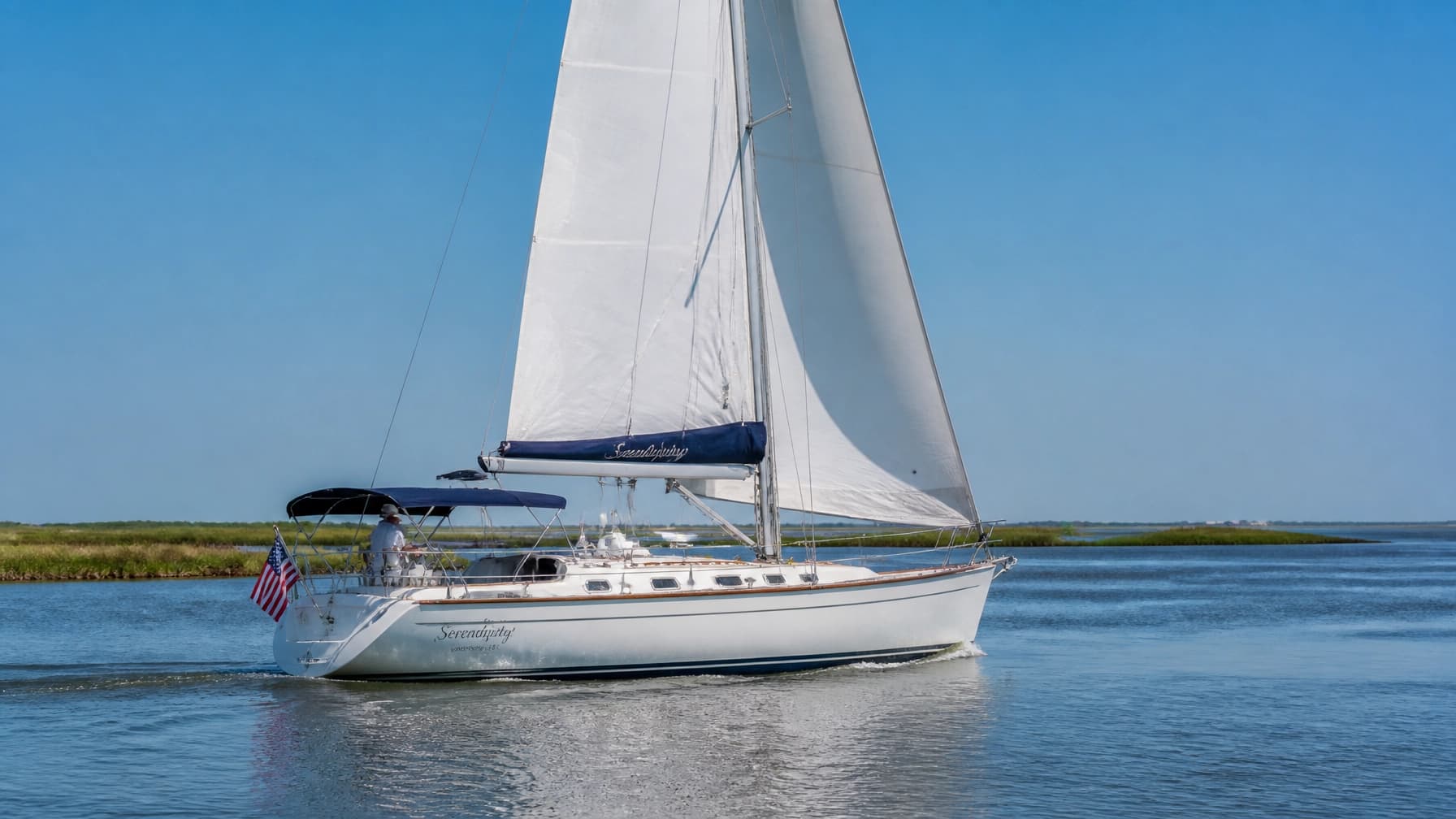
For boaters based on the upper Texas coast, particularly those looking for yachts for sale in houston texas, the Intracoastal Waterway is one of the most consequential pieces of marine infrastructure within reach. It connects Galveston Bay to the rest of the Gulf coast, makes long-range cruising possible without the need for offshore passages, and on any given day handles a steady procession of commercial tows, recreational cruisers, fishing boats, and shrimpers moving through one of the busiest working waterways in North America.
Operating confidently on the ICW requires a particular combination of skills: reading the unique marker system, communicating with commercial traffic on the right VHF channels, understanding the courtesy and right-of-way conventions, and developing a feel for the rhythm of the waterway. None of it is difficult. Most of it is simply unfamiliar to recreational boaters whose experience has been confined to the open bay.
This primer covers the practical fundamentals.
What the ICW Is
The Intracoastal Waterway is a continuous, navigable inshore route running along the U.S. Atlantic and Gulf coasts. It is composed of two principal segments. The Atlantic Intracoastal Waterway extends from Norfolk, Virginia, to Key West, Florida. The Gulf Intracoastal Waterway : typically abbreviated GIWW, and the segment most directly relevant to Texas boaters : runs from Carrabelle, Florida, across the northern Gulf to Brownsville, Texas. Together they form an inshore route of more than two thousand miles, allowing protected travel from the upper East Coast to the Mexican border with only limited offshore exposure required at certain transitions.
For Kemah boaters, the GIWW is the operative segment. It passes directly through Galveston Bay, intersects with the Houston Ship Channel, and continues both east and west along the Texas coast. A boat departing Kemah and heading east on the GIWW can reach Louisiana, Mississippi, and the rest of the Gulf coast without venturing offshore. A boat heading west reaches Freeport, Port O’Connor, Aransas Pass, and ultimately the Rio Grande.
Reading ICW Markers
Navigation in U.S. waters generally follows the IALA-B buoyage system : “red, right, returning” when entering from the sea. The ICW overlays a second convention on top of this, and understanding it is essential.
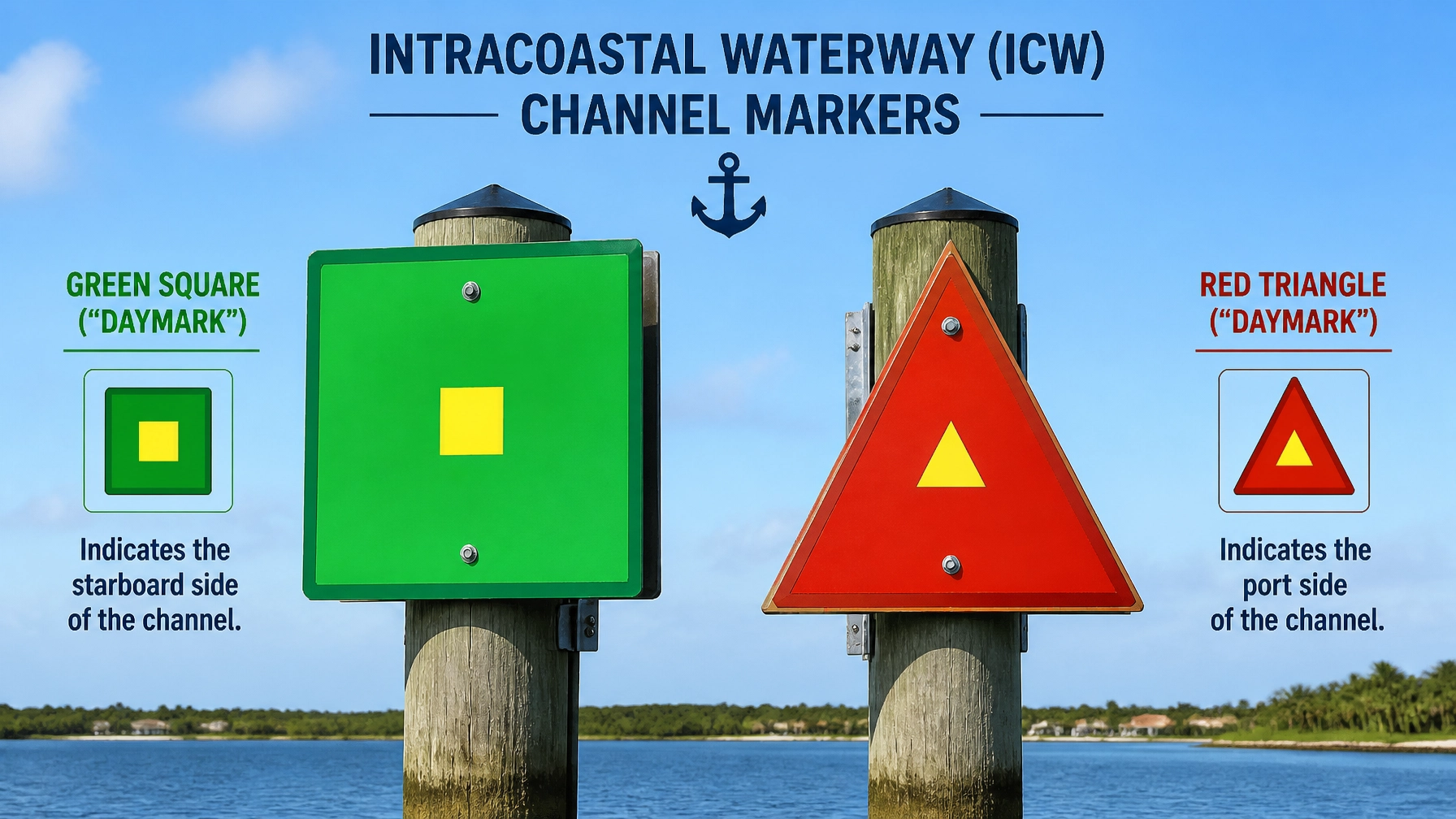
Aids to navigation along the ICW carry a small yellow symbol : either a triangle or a square : superimposed on the standard mark. The yellow symbol indicates the mark’s role for vessels following the ICW, regardless of what role the mark plays for vessels in any intersecting channel.
A yellow triangle indicates the mark should be treated as a red ICW mark. A yellow square indicates the mark should be treated as a green ICW mark. The standard “returning from sea” convention applies: on the GIWW, vessels traveling west are considered to be returning, so yellow triangles are kept to starboard and yellow squares to port.
This becomes practically important where the ICW crosses or coincides with channels coming in from the open Gulf. A red mark in an entry channel may also carry a yellow square, indicating it functions as a green mark for ICW traffic. In these areas, recreational boaters who watch only the red and green and ignore the yellow can find themselves on the wrong side of the channel. The yellow takes precedence for vessels following the ICW.
VHF Radio on the ICW
The single biggest adjustment for recreational boaters moving from open-bay operations onto the ICW is the expectation that they will be paying attention to VHF radio more actively than they may be used to. Two channels in particular matter.
Channel 16 is the standard hailing and distress channel, monitored throughout U.S. waters. ICW operations do not change this.
Channel 13 is the bridge-to-bridge navigational safety channel. By federal regulation, commercial vessels are required to monitor channel 13. It is the channel where commercial traffic : tugs, tows, towing vessels, and the larger ships in the navigable channels : coordinate their movements with each other and with any vessel they need to communicate with. A tug working a tow will typically have channel 13 as the primary working channel and channel 16 as a secondary monitor.
For recreational vessels operating on the ICW, the practical expectation is dual-channel monitoring: keep channel 16 active for general traffic, and also monitor channel 13 to hear what the commercial traffic around you is saying. Most modern fixed-mount VHF radios include a dual-watch or scan function that handles this automatically.
This second point matters more than recreational boaters often realize. The tug captain working through a narrow stretch of the ICW is not going to call you on channel 16 to coordinate a meeting or a pass. He is going to call you on 13. If you are not monitoring 13, you may not hear him : and on a working waterway, missing a call from a commercial vessel that needs to coordinate with you is not a small thing.
Talking to Commercial Traffic: The One Whistle / Two Whistle Convention
This is the area where recreational boaters most frequently encounter terminology that confuses them, and it is worth understanding clearly.
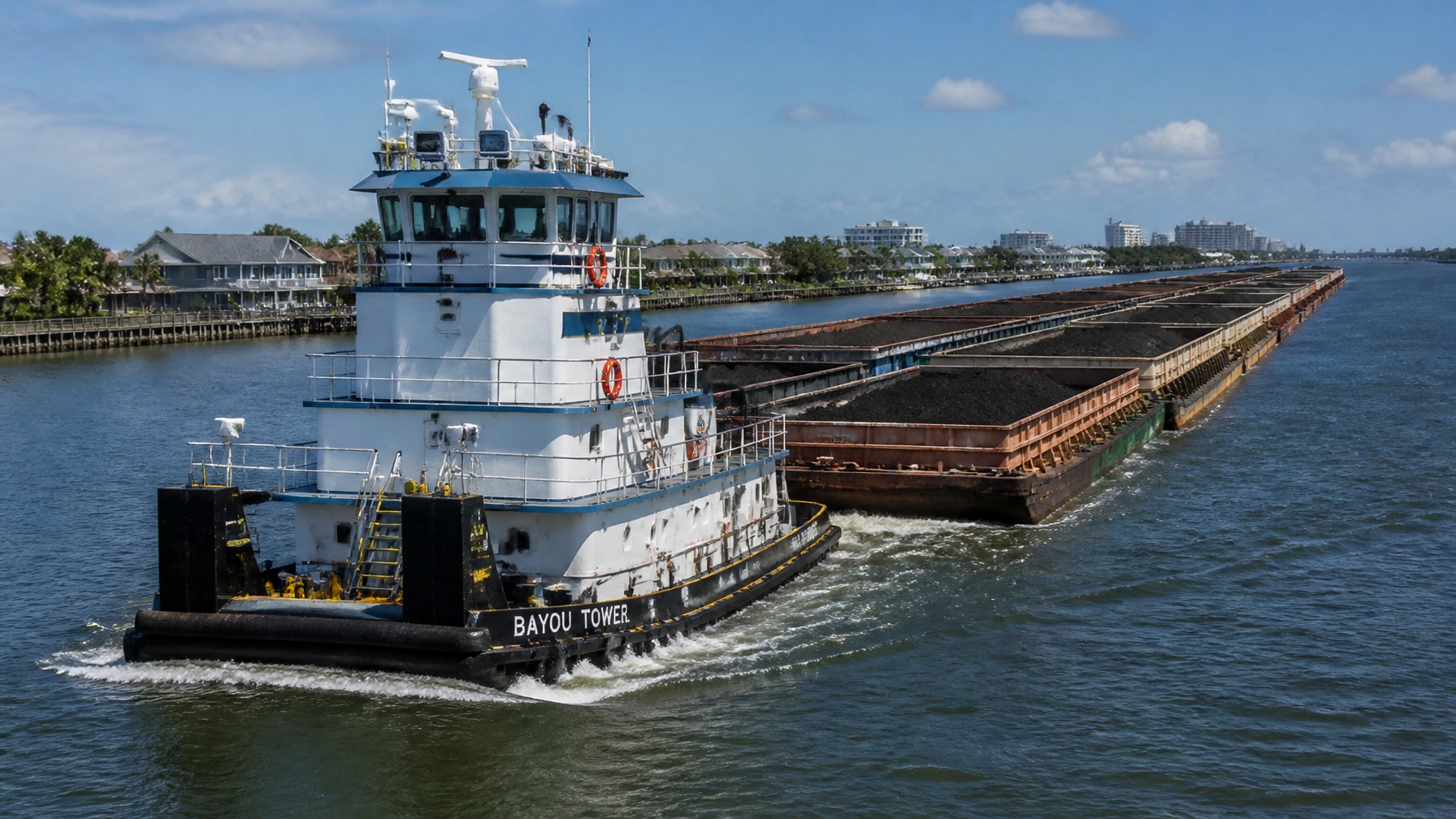
When a commercial vessel : most commonly a tug pushing or pulling a tow : needs to coordinate a meeting or an overtake with another vessel, the captain will typically call on channel 13 and propose a passing arrangement using one of two phrases:
“I’ll see you on the one,” or “Let’s do it on the one whistle.”
“I’ll see you on the two,” or “Let’s do it on the two whistle.”
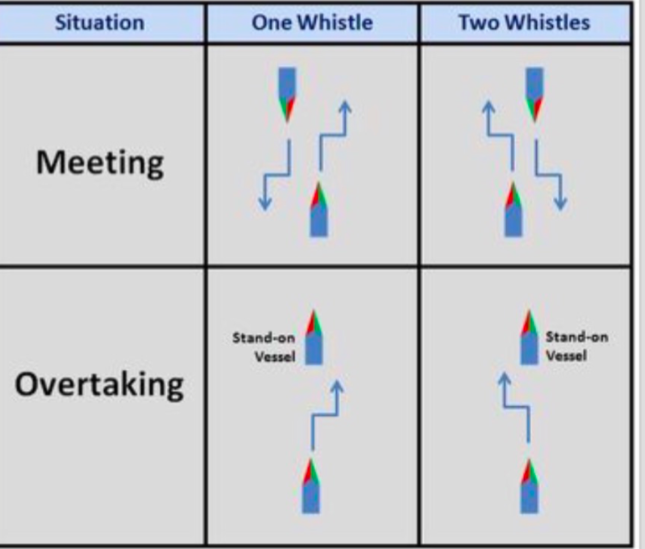
Translated into plain English:
These phrases reference the traditional whistle signal conventions codified in the Inland Navigation Rules. In the days before radio, a vessel signaled its intentions to another vessel by sounding short blasts on its whistle. One short blast meant “I intend to leave you on my port side.” Two short blasts meant “I intend to leave you on my starboard side.” The radio conversation simply substitutes spoken language for the original whistle signal.
“One whistle” means the two vessels will pass port-to-port: left side to left side. The other vessel will be on your port side as you pass. This is the standard meeting configuration in open water and the most common arrangement on the ICW.
“Two whistles” means the two vessels will pass starboard-to-starboard: right side to right side. The other vessel will be on your starboard side as you pass. Captains call for this arrangement when the geometry of the waterway, the position of other vessels, or specific channel conditions make a port-to-port pass impractical.
This is the part that catches many recreational boaters off guard. The phrase “on the one” feels like it should mean “pass on the right”—because many other contexts associate the number one with the right side, or because the phrasing suggests “first” or “starboard” by some other intuition. It does not. One whistle is port-to-port. Two whistles is starboard-to-starboard.
In an overtaking situation specifically—which happens more often on the ICW than head-on meetings—the same convention applies. If a tug overtaking from behind says “I’ll catch you on the one,” the tug intends to leave you on its port side as it passes. That means the tug will pass on your starboard side. If the tug says “I’ll catch you on the two,” the tug will pass on your port side.
The correct response when a tug captain proposes a passing arrangement is simple: confirm the arrangement on the radio, hold a steady course, and reduce speed if appropriate to let the maneuver finish cleanly. A clean exchange sounds like this:
“Tug Mary Jane, this is recreational vessel Wind Dancer, I’ll see you on the one, holding course.”
That is enough. The tug captain knows you understood, knows you will not do anything unexpected, and can complete the pass with confidence. The single biggest service a recreational boater can do for commercial traffic on the ICW is to answer up clearly, agree to the proposed arrangement, and then do exactly what the two of you agreed to.
Sharing the Waterway with Tows
A loaded tow is among the least maneuverable vessels on the water. A tug pushing four loaded barges may be several hundred feet long, has limited stopping ability, and cannot easily adjust course around a recreational boat that wanders into the wrong place. The default assumption on the ICW should be that commercial traffic has practical priority for entirely practical reasons: if anyone is going to maneuver, it should be the smaller, more agile vessel.
Two other considerations are worth understanding:
The wake from a passing tow can be substantial, particularly in narrow sections where the displaced water has nowhere to go. A recreational boat encountering an oncoming tow should slow, turn the bow slightly to take the wake at an angle, and ride through it under control.
The bow wave that precedes a heavily loaded tow in a confined channel can pull a smaller vessel toward the tow. Maintaining a healthy lateral distance and avoiding the area immediately ahead of a working tow is sensible.
Bridges, Locks, and Channel Intersections
The ICW passes through bridges, locks, and channel intersections at regular intervals. Most ICW bridges are either fixed (with charted clearance), opening on signal, or opening on schedule. Bridge tenders typically monitor channel 9 or channel 13, depending on the bridge; local cruising guides list the specifics. Calling ahead by VHF is standard practice for opening bridges.
Locks operate on their own protocols and timing. Cruisers crossing the Brazos River Floodgates west of Freeport, or the Colorado River Locks further west, should consult current cruising guides for procedures.
Channel intersections deserve careful attention, particularly where the ICW crosses ship channels heading into deep-water ports. Commercial traffic on the intersecting channels may have priority, and the marker system can become momentarily confusing as the ICW yellows compete with the channel’s own reds and greens for attention.
A Practical Note on First-Time ICW Cruising
For boaters used to the open bay, the first trip onto the ICW can feel busier and more procedural than they expected. The radio is more active. The traffic is more varied. The markers require more attention. And the etiquette around commercial vessels is unfamiliar.
The learning curve, however, is short. After two or three trips, the rhythm becomes clear: monitor 16 and 13, watch the yellow markers, give commercial traffic the room it needs, answer up clearly when a tug captain calls, and enjoy a stretch of cruising that opens up the entire Texas coast : and well beyond : without the open-water exposure of an offshore passage.
A Closing Note
The Intracoastal Waterway is one of the great underappreciated assets of Texas coastal boating. It transforms the operating range of a typical recreational vessel and connects the upper Texas coast to a remarkable network of destinations. Confident ICW operation is well within reach of any owner willing to invest a modest amount of time learning the conventions.
Little Yacht Sales has been working with Gulf Coast cruisers for decades, and our brokers know the GIWW well : from short hops to Freeport and Port O’Connor, to the longer routes east to Florida and beyond. Whether you are searching for sailboats for sale in texas or the best boats for sale in kemah tx, our team is uniquely qualified to help you find the right vessel for your next adventure. For owners considering boats with ICW cruising specifically in mind, or for those simply wanting to discuss what a particular vessel might be capable of, our brokers are happy to talk it through. Give us a call.