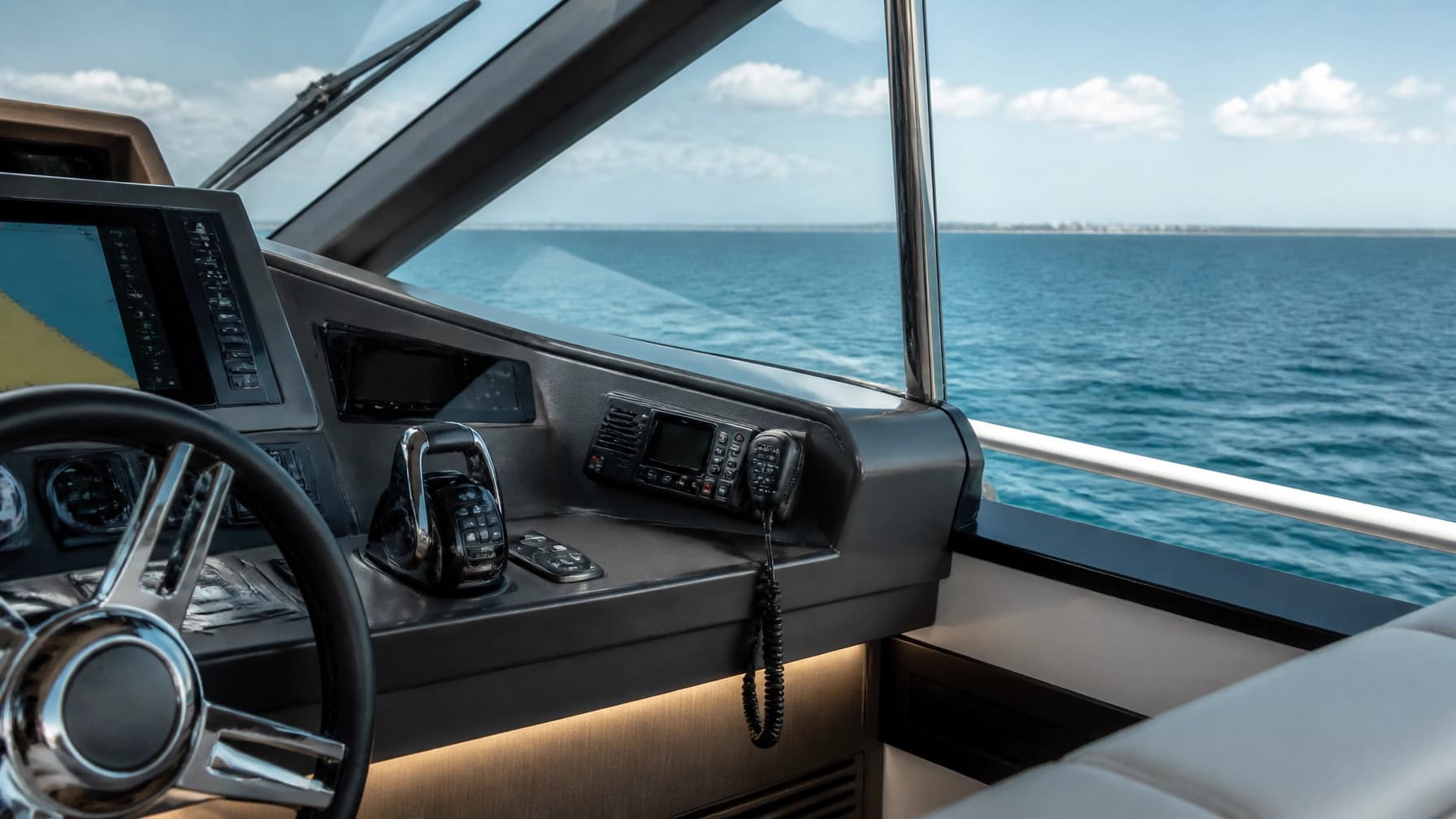
Among the equipment installed on most recreational vessels, the VHF radio is one of the most consistently underused. It sits in its bracket above the helm, occasionally murmuring with chatter from the channel sixteen monitor, and many owners — particularly newer owners — give it roughly the attention they give a smoke detector: a vague awareness that it is important, an unsettled suspicion that they do not actually know how to use it well, and a quiet hope that they will not need to.
This is unfortunate. A properly understood VHF radio is one of the most useful pieces of equipment on the boat, well beyond its role as a communications backstop. It is how you talk to bridge tenders, hail a marina to confirm a slip, coordinate with the boat anchoring next to you, listen to a weather update, or check in with a friend on another boat across the bay. The skills involved are not difficult; they are merely unfamiliar. A modest investment of time in understanding what the radio does and how it is meant to be used pays for itself many times over.
This guide covers the practical fundamentals every recreational boater should know.
What VHF Is — and Why It Still Matters
Marine VHF (Very High Frequency) radio operates in a dedicated band reserved by international agreement for marine communication. It is line-of-sight, meaning effective range depends largely on antenna height — typically five to ten miles for handheld radios with short antennas, and twenty miles or more for fixed-mount radios with antennas at the top of a sailboat mast or on the cabin top of a powerboat.
In an era of cell phones and satellite communicators, the obvious question is whether VHF still matters. The answer is yes, and for several reasons. VHF is the communication channel actively monitored by the Coast Guard, marina operators, commercial traffic, bridge tenders, lock operators, and most other recreational boaters. It works when cellular coverage does not. It runs on a power budget compatible with a boat’s electrical system. And it is the only practical way to make a broadcast that other nearby vessels will actually hear. A cell phone reaches one person at a time. A VHF transmission reaches every boat within range that has its radio on — which on a typical bay weekend means hundreds.
Fixed-Mount and Handheld
Most well-equipped boats carry both.
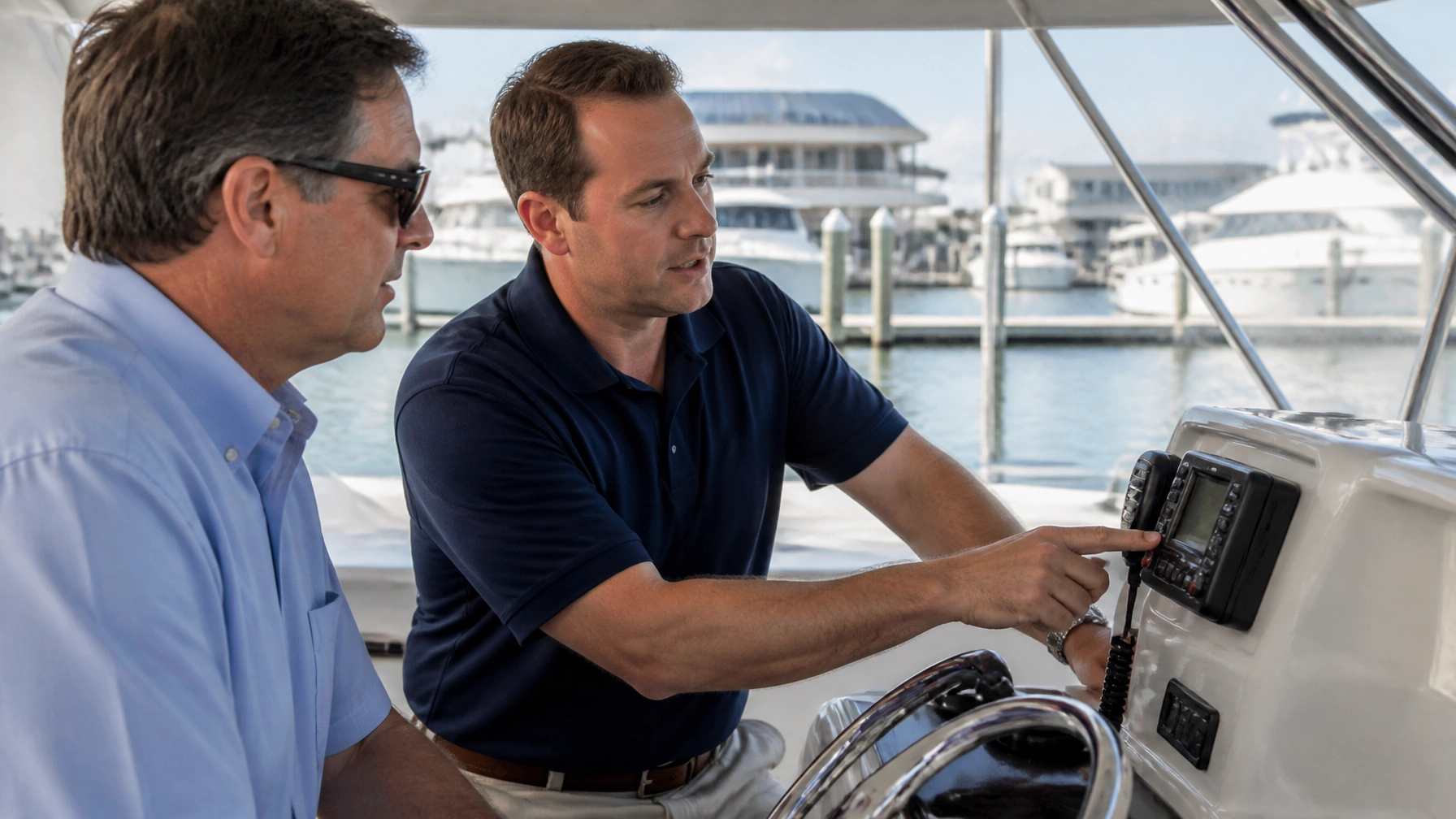
A fixed-mount radio is installed at the helm, draws power from the house battery system, transmits at twenty-five watts on most channels, and is paired with a dedicated antenna mounted as high as the rigging allows. This is the primary radio. Range is best, audio quality is best, and integration with onboard GPS is straightforward.
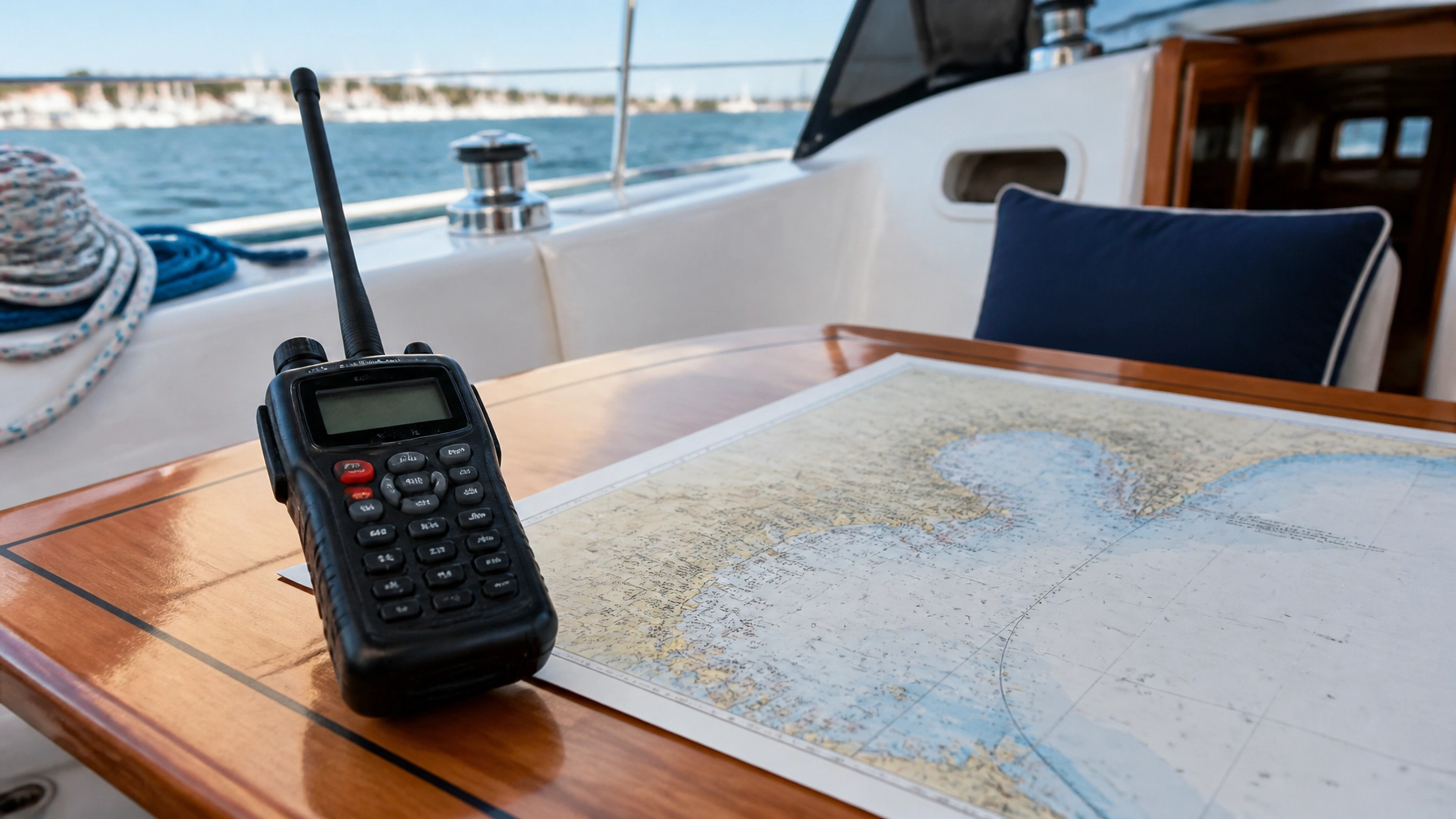
A handheld radio transmits at five to six watts, is battery-powered, and can be carried in the cockpit or stowed below. It serves three useful purposes: a backup to the fixed-mount in the event of electrical failure, a portable solution for dinghy operations or shore parties, and a working radio on smaller vessels where a fixed installation is not practical.
For any boat operating beyond casual day cruising, the combination of both is sensible. The handheld in particular is inexpensive insurance against the failure of the primary system at exactly the moment it is needed.
The Channel Landscape
The marine VHF band is divided into specific channels, each with a designated purpose. The full list runs to several dozen, but a handful account for nearly all recreational use.
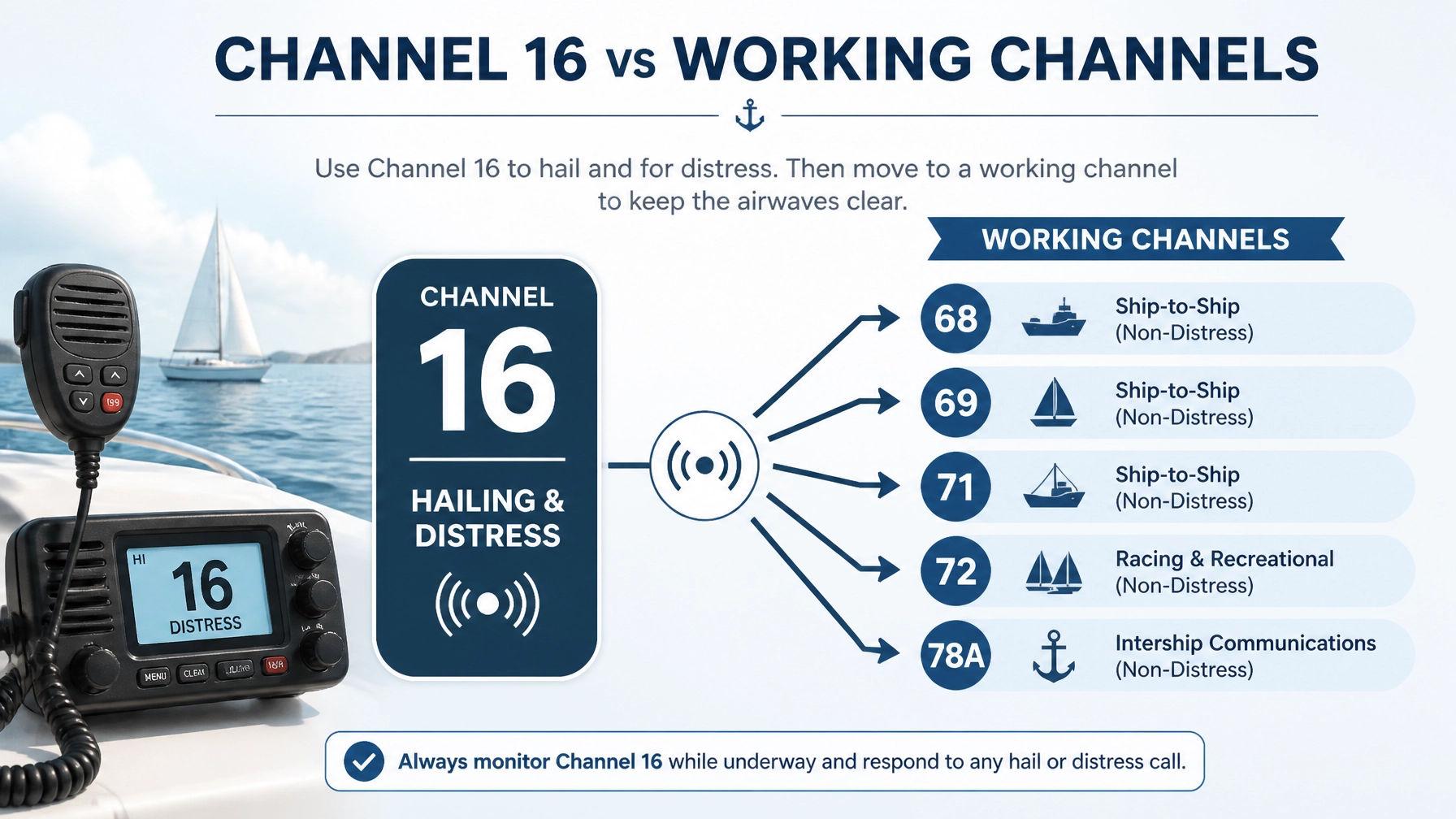
Channel 16 is the international hailing and distress frequency. By regulation, vessels equipped with VHF are required to monitor 16 while underway. It is used for two purposes only: hailing other vessels (briefly, before switching to a working channel) and reporting emergencies. Casual conversation on 16 is both inappropriate and prohibited.
Channel 13 is the bridge-to-bridge navigational safety channel, used primarily by commercial traffic and recommended for coordination with ships, tugs, and tows when navigation requires it.
Channel 22A is the Coast Guard’s working channel. After hailing the Coast Guard on 16, conversation typically moves to 22A.
Channels 68, 69, 71, 72, and 78A are common recreational working channels. After hailing another vessel on 16, the two parties agree to switch to one of these channels to conduct their actual conversation. This is the heart of normal VHF etiquette: keep 16 clear by moving working traffic elsewhere.
Channel 9 is an alternate hailing channel in some regions and is often used for radio checks to avoid clogging 16.
Channel 70 is reserved for Digital Selective Calling and is not used for voice communication.
Weather channels (WX1 through WX10) carry continuous NOAA weather broadcasts. These are receive-only and do not transmit. Knowing which weather channel covers your area is worth a few minutes’ effort.
DSC and Your MMSI
Nearly every VHF radio sold in the last fifteen years includes Digital Selective Calling, or DSC. This is a feature that allows the radio to send a digital message — most commonly an automated alert that includes the vessel’s position — at the press of a button.
To use DSC, the radio must be programmed with an MMSI (Maritime Mobile Service Identity), a unique nine-digit number assigned to the vessel. Registration is free for recreational vessels operating in U.S. waters, available through BoatUS. The MMSI must be registered to the specific vessel and kept current — particularly when a boat changes ownership, which is when MMSI records most often fall out of date.
It is worth confirming, on any newly purchased boat, that the radio’s MMSI is registered correctly and that the radio is connected to the onboard GPS. Both are common items on a survey report, and both are straightforward to address.
Hailing and Basic Etiquette
A standard hail follows a consistent format. To call another vessel, you transmit on channel 16:
“Sea Breeze, Sea Breeze, this is Wind Dancer, Wind Dancer, channel sixteen, over.”
The called vessel responds, and the two parties agree on a working channel:
“Wind Dancer, this is Sea Breeze, switch and answer six-eight, over.”
Both switch to channel 68 and continue the conversation there. That is the entire pattern. Once you have used it a handful of times, it becomes second nature.
A few related conventions are worth knowing:
- “Over” indicates you have finished speaking and expect a response. “Out” indicates the conversation is concluded. “Over and out” is a mixed phrase that does not exist in proper protocol.
- The phonetic alphabet (Alpha, Bravo, Charlie…) is used when clarity of letters matters, particularly for boat names that include unusual spellings.
- Transmissions should be brief. Long-winded chatter on a working channel is poor form because others are waiting to use it.
- The microphone is held a few inches from the mouth, with the push-to-talk button pressed cleanly and released cleanly. Half-pressed transmissions and the sound of someone fumbling with the mic are the most common audio problems on the band.
The Three Priority Calls
Three priority calls exist within international radio protocol, and recreational boaters should at least recognize them when heard.
Mayday is the highest-priority call, used in situations of grave and imminent danger.
Pan-pan (pronounced “pahn-pahn”) indicates urgency — a situation that is concerning but not immediately critical. A disabled engine in a busy channel, for example, might warrant a pan-pan call.
Securité (pronounced “say-cure-eh-tay”) indicates a safety message — most often a navigational hazard or weather alert. It is the call you will hear most often as a casual listener, typically from the Coast Guard broadcasting a notice to mariners.
These calls follow specific protocols, and learning them in detail is worth an afternoon. A formal course through the U.S. Power Squadrons, the Coast Guard Auxiliary, or BoatUS can be completed in a weekend and is among the better investments a new owner can make.
A Word on Habit
The single most useful habit a boater can adopt with respect to VHF radio is, simply, turning it on. Keep the radio on, monitoring 16, whenever the boat is underway. This is true even on a quiet Saturday afternoon on a familiar bay. Being a part of the local marine communication network is meaningful. You will know when weather changes, when traffic advisories are issued, when a nearby boater needs help, and when commercial traffic is making a move that affects you.
Owners who turn the radio on as part of their normal departure routine, and who take the time to actually understand what they are hearing, find that the boat operates with a noticeably greater sense of competence and connection to the broader marine community.
A Closing Note
VHF radio is not difficult equipment. But, you gotta use it. Which means making a few hails, learning the working channels for your local area, registering the MMSI properly, and getting past the initial unfamiliarity that keeps so many capable boaters from picking up the microphone.
Little Yacht Sales has been working with Gulf Coast boaters for decades, and the brokers in our Kemah and Key West offices are happy to answer questions about onboard electronics — including how VHF and DSC integration looks on the specific boats in our inventory. For owners interested in formal training, the local Power Squadron and Coast Guard Auxiliary chapters offer excellent introductory courses throughout the year.
Are you looking to buy your next boat? Check out our current inventory of cruising sailboats for sale and powerboats for sale at Little Yacht Sales. Whether you’re hunting for yachts for sale in Texas or the perfect boats for sale in Kemah, TX, our team in Kemah and Key West is ready to help you navigate the process.