LITTLE YACHT SALES
Saturday, July 11, 2026 • 10 AM – 4 PM • Both Locations
Lately we’ve been fielding more and more questions about cruising under power — and about trawlers in particular. Some of the folks reaching out are making the transition from sail to power; others have been powerboat people all along and are simply ready for their next boat.
What counts as a “trawler” has changed quite a bit over the years. The heyday of the classic trawler ran from the late 1970s into the early 1990s, when names like Grand Banks, Marine Trader, DeFever, Nordhavn, and Selene defined the category. What many people don’t realize is that plenty of other builders were turning out boats that owners ran just like trawlers — Hatteras, for one, was building what were essentially trawlers as far back as the late 1960s. Those early boats were slow and heavy, with small engines and full-displacement hulls. By the 1990s, even Grand Banks recognized that buyers wanted to move faster than the traditional 6–8 knots, and began fitting larger engines that pushed speeds up to 15–17 knots.
Today, the best-selling trawler in the world by volume is the Beneteau Swift Trawler — a line we’re proud to represent as a dealer, built in lengths from 37 to 63 feet. These are boats that sip fuel at displacement speeds yet still have the muscle to get up and go when you need it.
Here’s what we’ve learned from talking with so many clients: most people don’t actually need a trawler in the strict sense. What they really want is a boat capable of a bucket-list voyage — say, the Great Loop or a run over to the Bahamas.
And the good news is that a lot of boats can do those trips — not just trawlers. Consider the Great Loop: it’s protected water nearly the entire way. It’s been completed by a man in his 70s in a jon boat, and even on a jet ski. One of our own clients ran the Loop in a Hatteras 65 and loved every minute of it. Two years later he did it again in a 33-foot Grady-White and enjoyed it even more, because the added speed let him cover far more ground.
The Bahamas are much the same. If you’ve been, you know the hardest part is crossing the Gulf Stream — roughly 50 to 60 miles. To put that in perspective, the Harvest Moon Regatta runs 150 miles offshore. You can leave Boca Raton for Green Turtle Cay, cover about 150 miles, and spend three-quarters of it in well-protected water. The point is the same: you can make the Bahamas crossing in all sorts of boats, not just trawlers. Down there you’ll see everything from Grand Banks to Sea Rays to Carvers.
One of the biggest shifts we’re seeing is cruisers moving from inboard diesels to outboards — a genuine change in the market. Is there still demand for the classic single- and twin-engine trawlers? Absolutely. We sell them all the time, and as the fleet ages, they’re getting harder and harder to find.
Join Us on July 11
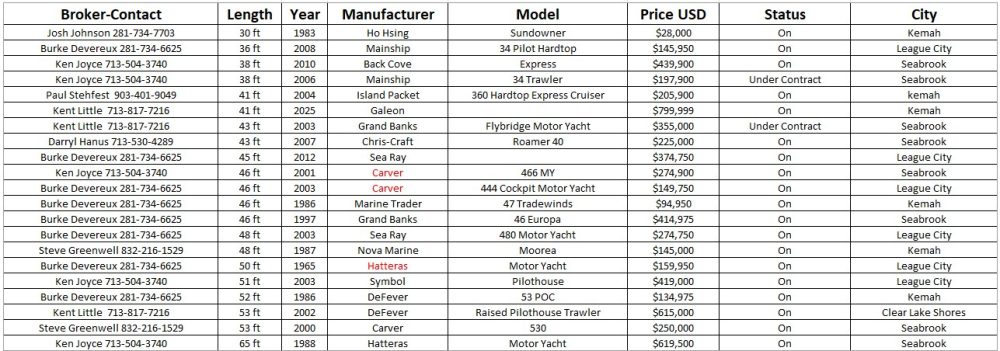
With all of this in mind, we’re hosting a Trawler & Powerboat Showcase on Saturday, July 11, from 10 AM to 4 PM. At both of our locations we’ll have on display the powerboats we think are best suited to the kinds of trips described above. A few of the boats we’d love to feature aren’t kept on-site and can be shown by appointment — so when you RSVP, please let us know which boats you’d like to see and we’ll set up a time.
And if you’re making the move from sail to power, you might enjoy an article we published a while back: The Trawler Talk: Transitioning from Sail to Power.
And if you’re in the market for a cruising sailboat, those will be available to see as well — plus we’ll be featuring a similar open house dedicated to sail in August.
RSVP today and tell us which boats you’d like to see.