
I have been, always will be a sailor at heart but when my wife and I sold our Catalina 350 about 5 years ago and I came across a local 2004 Mainship 40 that was a bit of a project, I bought it and started a refit. $160K+ later it’s a nice boat. We moved it over to Florida in Nov 2019 and did the Florida Keys. She’s cruised a lot of Florida since and been to Ft Lauderdale, up to Stuart, thru the Okeechobee and back to Ft Myers. A month before Hurricane Ian in Sept 2022, we had just moved it to Sarasota. In Fall of 2023 I sold it and moved into a 2007 Mainship 430 also here in Texas.
As you well know most sailors transition to power in the form of some trawler. The biggest issue I see when helping clients with this transition is the $100-200K+- sailor that thinks he’s going to sell his sailboat and replace it with a $100-200K trawler. For the most part and with few exceptions, $100K or sub $100K trawlers are in my world shall, we say subpar what an equivalent sailboat that age would be. The other thing most sailors don’t understand is the maintenance in power vs sail is not just a little more it’s A LOT MORE! It’s not just that a sailboat is a 1–5-gallon oil changes vs. the power boat is 10 gallons etc. It’s more systems; Generators, multiple A/C systems, multiple pumps etc etc.
The first boat every one thinks of when they think “Trawler” is a Grand Banks (GB). They are nice boats and have been around forever, but they are for the most part 20-30 years+ old and they have inherent design issues. The top three are Black Iron Fuel Tanks, Leaking Teak Decks (leading to deck core issues) and the last most folks don’t know because they are painted, but the window frames are wood and will rot out.
The cheaper a GB the more likely it’s got some or all of these issues. Another issue with all GB’s is that they cannot be truck shipped like a sailboat as the flybridges do not come off. They are glassed on. So, an East coast boat that needs to go to the West Coast has to be put on an ocean freighter ($50K+). So, if you want a west coast boat, like to do NW and Alaska and it’s got to be a Grand Banks we should find you one out there. Also, one additional note about that, West Coast Boats are going to be 10-25% higher in price than ANYWHERE else (except the Great Lakes) in the US. The upside is the weather is kind to them and a 30-year-old boat can look like it’s 10 years old.
The biggest question in a trawler is do you want to go fast or slow? Every sailor at first says slow because they are used to motoring at 5 knots so 10 knots seems like that is really fast. True and not true. Most GB 42’s with the original Lehman 120-135hp’s will do 10 knots at the top end. They were really 7-8 knot boats. Granted there are some GB’s with huge engines that will get up to 15-16kts but at huge fuel consumption because they are overpowering a displacement hull with horsepower.
There are sometimes when 10 knots or faster looks very appealing. It makes 100-mile days that used to take us 20 hours in a sailboat to be only 10 hours long, and for most times of the year that can all done in daylight hours. My thinking from having/using a boat in Florida is we motored everywhere we went in Florida so why not have a power boat that does 12-15 kts and cut my time in a third? The issue has been with my boat (the original MS 400 with a single 370hp Yanmar) that it just will not perform in the 12-15kt range it is supposed to. It’s super nice at 7-8 knots and burns 3 gallons an hour at that speed but I didn’t cut my time by a third, but it did allow us to do 50-60 mile days in 7-8 hours while not burning that much fuel. It’s also one of the reasons we sold it and moved into the twin engine MS 430 which would run up to 22 knots but burn a ton of fuel. Ironically on the trip from Texas to Florida we ran at 7 knots thru the ICW and only burned 3 GPH at that speed.
So, most sailors want to go slow and burn less fuel, but we can also think of a lot of other boats out there that are not trawlers, that are stabilized and that are super nice that are twin diesel engines and could easily cruise at 10-12-15 or even 20+ knots and be just as comfortable as any Grand Banks. But generally thinking a boat like that is going to be in the 50’+ range. Like the old 1980-90’s motor yachts built by Hatteras and Viking and others that were in the 50-70’ range. But these boats are HUGE and OLD but some have been wonderfully restored and reoutfitted and they are good buys.
Now you might want to be the true trawler traditionalist and want to go “long range” and slow with a single diesel. Those type of trawler vessels would be a Nordhavn, a Selene, a Krogen, a Defever or a Krogen or any of the other long range custom boats that are singles but usually with a smaller get home diesel. They hold 2-5000 gallons of fuel and could literally be transatlantic boats , but they won’t go over 9-10 knots unless they fall off a wave.
There are more modern looking trawlers out there that are faster: Marlow, Fleming, Offshore, Beneteau Swift and newer Grand Banks and their offshoot East Bay (which are mainly expresses no flybridge) and now their newer style Palm Beach all have models that will run in the mid teen to low 20 range+.
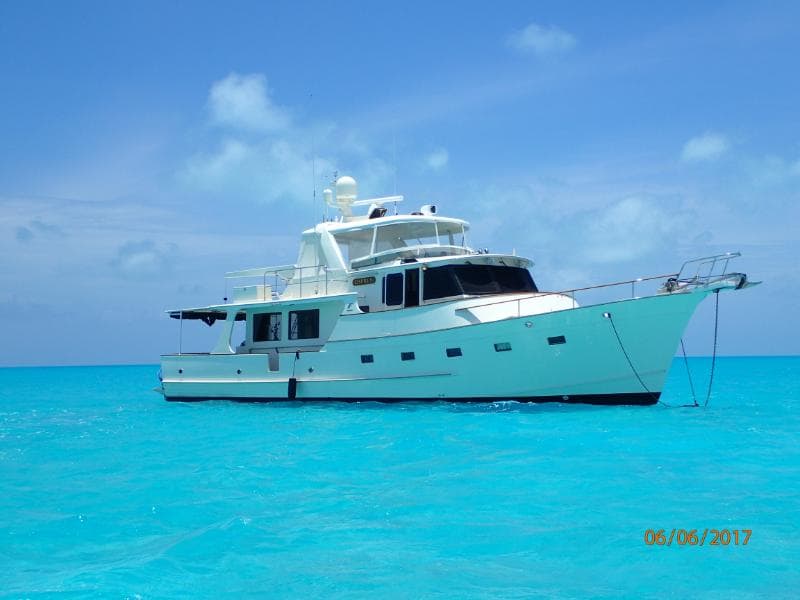
Fleming 55s is a great boat. I have spent a lot of time cruising the Florida and the Bahamas on one I sold some good friends. See the picture above in the Exumas. Again, Grand Banks has nice more modern (newer than 2000) designs with less issues in the 47-52’ size but they are very hard to find. All these boats can be run at trawler speeds. So could quite literally “just about any boat” if it’s run properly. In my travels I have seen boats that I would have thought twice about taking offshore running all around the Bahamas and they got across that Gulf Stream somehow.
There are other builders also. A lot of people are doing the loop and island cruising in boats like Sabre express cruisers from 36-48 feet. These down east style express cruisers have a lot of appeal because they go under just about every bridge on the loop. Beneteau is unique in their Swift Trawler range which is 35-62’. I was a dealer in the early 2000’s when the first Swift 42 came out and we ran it 150 miles offshore on a Harvest Moon Regatta to “test it”. We ran 15-20 kts in 3’ seas and did the 150 miles in 6 hours. We tried to break the boat. See what came loose. Nothing happened and it was actually very comfortable. The designs have been heavily refined over the years with 5 different models. They are Literally a modern-day trawler that can have speed when needed and slow down when not and the larger versions have Seakeeper gyro stabilization. Which is a whole another topic-stabilization.
Just remember speed costs money in both fuel and bigger engine maintenance. A turbo on a 76hp Yanmar in a sailboat is $2K. The same turbo on a Yanmar 440hp is about $10-12K. Both will need maintenance and or have to eventually be rebuilt or replaced.
There is the “sort of trawlers” trawlers. That is where our Mainship and a lot of other “production style boats” fit in. In the Mainship the boat started as a 350/390 from 1995-2003 and then came out with a much improved much larger version, the 400, that they built from 2004-2010. When I have someone coming in with the “I want a (old) GB 42 trawler for 100-150K” idea, I usually try to find them a Mainship 390-400 to view because while the boat is a production boat it really works well and the GB’s they want to buy in that range need work and they are 30+ years old. The Mainship is still going to be 15-20 years old but there are no teak decks, no black iron tanks, and little wood outside. The Mainship 400 has some displacement, and it comes in single or twins and has decent fuel and water. The layout works well for a couple (one head) with occasional guests. However, if you want two cabins and two heads, that sedan style trawler (all staterooms forward) layout won’t work for you. That is for sure either a Grand Banks in the Classic trunk cabin model or a similar trawler in a motoryacht version of which there are dozens of models by decent builders.
This type of boat, though while it does most things pretty well it lacks one thing most trawlers or any long distance boat needs or eventually everyone wants and that’s stabilization. Either from fins, gyro or the big mechanical outriggers that they use on the Nordhavn’s. Stabilization makes a huge difference in the comfort level especially offshore and when you are higher up on a Flybridge. The higher you are off the water there is a lot more pitching. That being said, most trawlers are not stabilized, but if you ever plan to go across oceans or huge bodies of water, you’re going to want it (and guess what, it’s going to also require maintenance). If the most you are going is 100 miles at time, then anchoring or in a marina, just about anything can do that. If you are doing the Great Loop, a guy literally did it on a jet ski and center console outboard boats do it all the time. Most of the waterways are protected except for the open waters of the Great Lakes. If you want to do the Loop there are a lot of boats to consider.
I have two owners that downsized from a Fleming 55 and Grand banks 52 and one is going down to the new express style down east boat. Not a trawler but cruises at 20+ and has a sea keeper gyro for stabilization. They have decided if they need more room than what this couple size stateroom boat offers, they can stay at a hotel dockside or put guests there, but they can leave Stuart and be across the gulf stream to West End, Bahamas in 3 hours if they want. Literally Stuart to Green Turtle, Bahamas in the Abacos is about 150 miles (one Texas Harvest Moon Regatta distance wise) and they can do it in a day if they want. Burn a lot of fuel doing it, yes but do it in a day. Speed in a boat also “adds” some stabilization as you are more on top of the waves rather than running through them.
So, think about do I want to go fast or slow, layouts (cabins/heads), size and a price range you want to be in but have an open mind that the trawler that might work best for you may not be an actual trawler.
The Brokers at Little Yacht Sales have over 150 years combined experience Exclusively in Yacht Sales. We know the market and we Know Trawlers. Call or email us, we can help you!
Kent Little