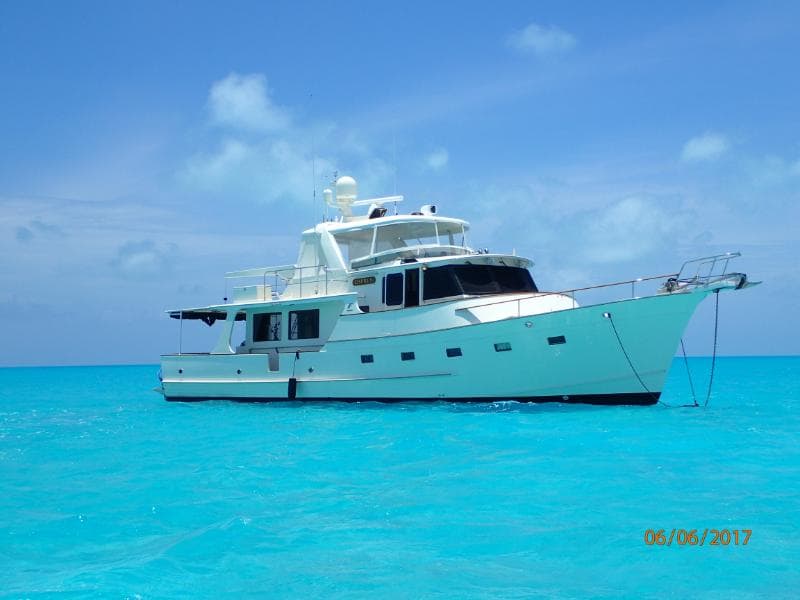
(Above picture is a beautiful Fleming 55 anchored in the turquoise waters of the Exumas.)
The Anchor Line
All of the gear, taken collectively, that lies between a boat and her anchor is called the Rode – whether it is synthetic fiber like nylon), chain, or a combination of the two.
Twisted Nylon
Nylon, in three-strand twist or double-braid form, is by far the most widely used material for anchor lines; other synthetics, such as Dacron, polypropylene, and polyethylene, have less desirable characteristics. Chain makes a good anchor rode, but its weight, while desirable for anchoring, may necessitate your having a winch or other mechanical assistance on board to hoist it. On a small boat, the weight of an adequate length of chain, stowed in the bow, may be too great for proper trim.
For anchoring, nylon’s greatest asset is its characteristic of stretching under load; it has a working elasticity of 15 to 25 percent. When a boat surges at anchor in steep seas, there is a heavy shock load on fittings and ground tackle-unless provision is made to absorb it gradually. Nylon’s elasticity does exactly that.
Some boaters unwittingly lose part or most of the advantage inherent in nylon by using too large a line. Within the limits of safe working loads, the smaller the diameter the greater the elasticity for given conditions. A practical limit is reached when small diameters, though rated high enough for breaking strength, are inconvenient to handle. Some experienced boaters use nylon as light as 3/8-inch (10 mm) in diameter on the working anchors of their 30-to 40-foot (9-12 m) craft. Nylon line is highly resistant to rot, decay, and mildew but can be damaged by rust from iron fittings or rusty chain. Nylon line should be stored out of direct sunlight to prevent a gradual deterioration from ultraviolet rays.
Braided Synthetic Line
Most nylon used for anchor lines is laid up by twisting three strands. Synthetics can, however, be laid up by. For anchoring (as well as mooring or towing), a braided outer cover of nylon surrounds a braided inner synthetic core-this is commonly called “double-braided” or “braid-on-braid” line. The result is a line of exceptional stability with no inherent tendency to twist by the nature of its lay. Consequently, it can be fed down into an anchor locker without fear of kinking.
When braided nylon is handled on deck, it is advisable to fake (or flake) it down in a figure-eight pattern, rather than the conventional clockwise coil used with twisted fibers. Because of the relatively smoother surface of braid, with more fibers to take the wear, chafing is less of a problem than it is with a twisted three-strand lay. Braided nylon retains an adequate degree of elasticity (14 percent at working loads, as against 25 percent for twisted nylon).
Chain
As the size of the vessel increases, so does the required diameter of nylon anchor line. For yachts 65 feet (20 m). or more, nylon would run to diameters up to 3/4 inch or larger. This is getting to a size that is difficult to handle; the alternative is CHAIN.
It should not be inferred from this that chain is unsuitable for use on smaller craft. Boats that cruise extensively and have occasion to anchor on sharp rock or coral often have chain; in some cases, it is regarded as indispensable-it stands chafing where fiber won’t. (I have used 250′ of 5/16″ all chain rode on a Catalina 350 that I owned. The boat handled that and a 50# anchor on the bow just fine.)
In larger diameters, the weight of chain makes a sag in the rode (called a CATENARY) that cushions shock loads due to surging from wave action on the boat. Once the slack has both taken up, however, the shock on been boat and anchor is very much greater than with nylon. You’ must thus be sure to use adequate scope with chain. Shock loads can be further mitigated by using a SNUBBER the short length of nylon line. After the anchor is set, one end of several feet of nylon line is hooked into a link in the chain between the boats deck and the water surface; the other end is made fast on deck. Then the tension on the chain is slacked off so that the load is carried by this short length of stretchable nylon line.
The three kinds of chain most used as anchor rode are “BBB,” “Proof Coil,” and “High Test.” Chain is designated by the diameter of material in the link, but the various types have links differing slightly in “length.” It is necessary to match the chain to the pockets of the WILDCAT (a pulley designed for use with chain, also called a GYPSY) of the anchor windlass. The differences in link length are slight, but they are enough to cause trouble if there is a mismatch. (Most windlasses have a capstan for line and a gypsy for chain, but special models are available where the gypsy can handle both.) Any type of chain may be used for anchoring-BBB is slightly stronger than Proof Coil; High Test is significantly stronger than either. The selection of a chain type and size for your boat involves several factors, the first of which is adequate strength. A safe standard to use is a WORKING LOAD- figured from the size of the boat and the conditions to be encountered-at 20 percent of the chain’s breaking strength when new. But you must also consider weight. The chain must be heavy enough to provide a proper sag to cushion shock loads, but the length required for normal anchoring depths must not be so heavy, when stored on board, that it affects the boat’s handling characteristics or even its safety. The weight factor may dictate a combination of chain and line.
Once you get your rode figured out, you’ll need to think about anchors and a snubber. More on that in another blog.
(Reprinted from Texas Mariners Cruising Association Newsletter May 2025. https://www.texasmariners.com/