
Once your offer has been accepted and the contract is binding, the transaction enters its most technically substantive phase: the survey and sea trial. For most buyers — particularly first-time buyers — this stretch of the process feels the most intimidating. It involves specialized professionals, technical vocabulary, and a written report that will shape the remainder of the negotiation.
The good news is that the survey period is also where you gain the clearest possible picture of what you are actually buying. It is the most important due-diligence opportunity of the entire transaction, and it exists precisely to protect you. Approached with the right preparation, it should feel less like a hurdle and more like a thorough, professional inspection of a significant investment.
This is Part 2 of our three-part series on the boat buying process. Part 1 covered working with a broker and structuring an offer; Part 3 will cover financing, insurance, closing, and documentation.
Choosing a Surveyor
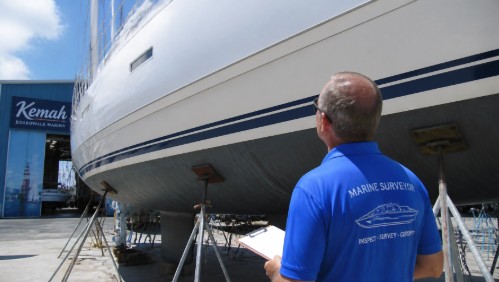
The marine surveyor is the most important independent professional you will hire during the buying process, and the choice matters substantially. A few principles are worth understanding from the outset.
The buyer hires and pays the surveyor. The surveyor works for you, not for the seller or the broker. This independence is essential — it is what makes the survey report a trustworthy document. Survey fees vary by region and vessel size, but typically fall in the range of twenty to twenty-five dollars per foot of length, paid directly by the buyer.
Accreditation matters. Two professional organizations set the principal standards: the Society of Accredited Marine Surveyors (SAMS) and the National Association of Marine Surveyors (NAMS). Surveyors carrying credentials from either organization have demonstrated experience, passed examinations, and committed to a code of professional conduct. Not every excellent surveyor holds these credentials, but their absence is worth questioning.
Specialization is worth considering. Surveyors typically develop expertise in particular categories — sail versus power, displacement hulls versus planing hulls, recreational versus commercial. A surveyor whose practice centers on the kind of vessel you are buying will produce a more thorough and more useful report.
Engine surveys are often separate. For boats with significant engine value — particularly diesel-powered cruisers and trawlers — a dedicated marine engine survey, performed by a diesel specialist, is highly recommended in addition to the general survey. The cost is modest relative to the potential exposure, and the depth of analysis is well beyond what a general surveyor will provide.
Your broker can usually provide a list of well-regarded surveyors working in the region. Whether or not you draw from that list, the choice is yours, and the surveyor will be in direct communication with you throughout the process.
What Happens During the Survey
A full pre-purchase survey is typically conducted in two stages and takes most of a working day.
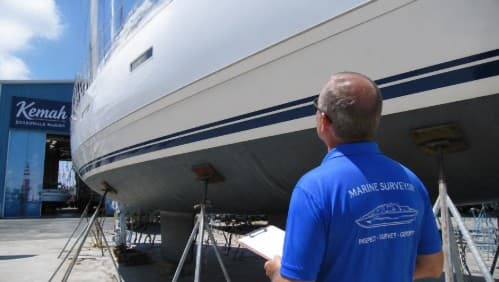
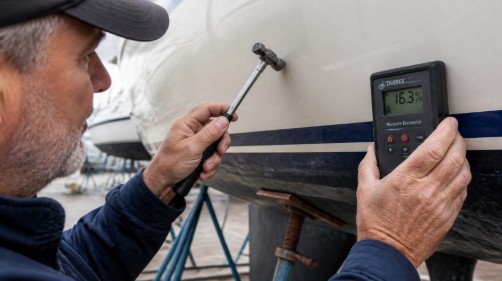
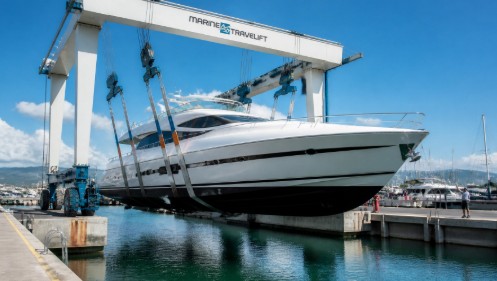
Out-of-water inspection. The vessel is hauled at a nearby yard, allowing the surveyor to inspect the hull, keel, rudder, running gear, through-hulls, propeller, and other underwater components. This stage uses visual inspection, moisture meter readings to identify potential laminate saturation, and percussion testing — light tapping with a small hammer — to identify delamination or core issues. The buyer is typically responsible for the haul-out fee, which is separate from the surveyor’s bill.
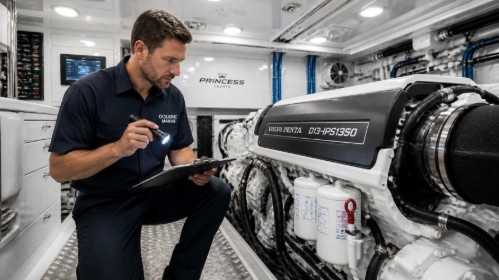
In-water inspection. Back in the water, the surveyor moves through the boat systematically: engine room and mechanical systems, electrical systems and battery banks, plumbing, fuel systems, sanitation, electronics, safety equipment, ground tackle, sails and rigging on sailboats, and interior condition. Everything is documented, in notes and in photographs.
Sea trial. The boat is operated under normal conditions, typically for an hour or two. The surveyor — and the engine specialist if one is involved — observes engine performance across the full power range, transmission behavior, steering, sailing performance where applicable, autopilot, instruments, and overall handling. Sea trials are most productive when the boat is operated as it would be in normal use: sails up if it is a sailboat, cruising speed held long enough to verify temperatures and pressures, and equipment exercised rather than merely turned on.
It is genuinely valuable for you to attend the survey and sea trial in person. You will learn an enormous amount about the boat in the course of a single day — far more than you could from any listing description — and you will have the surveyor available to answer questions in real time. Most surveyors welcome the buyer’s presence and find that engaged buyers ask useful questions.
The Survey Report
The written survey report typically arrives within a few days of the inspection. It is a detailed, document-of-record style report, often running thirty to sixty pages, covering the full scope of the inspection along with photographs of significant findings.
Findings are generally organized by severity, in categories such as:
- Safety items — conditions that affect the immediate safe operation of the vessel and should be addressed before further use
- Recommended items — conditions that should be corrected in the near term but do not preclude safe operation
- Cosmetic items — issues of finish or appearance that do not affect function
The report also typically includes a fair market value opinion, which most marine insurance providers will require in order to bind coverage. This makes the survey report a document with consequences beyond the immediate purchase decision — it follows the boat into the insurance file and, often, into future transactions.
It is worth setting expectations honestly here: very few surveys come back clean. Almost every used boat — and many new ones — will show items that warrant attention. A survey report with twenty or thirty items is normal, even on a well-maintained vessel. The goal is not a perfect report but a clear, complete picture of the boat’s actual condition.
The Post-Survey Decision
Once the report is in hand, you have three options under the standard purchase agreement.
Accept the vessel as it stands. If the survey confirms what you expected and the findings are acceptable, the transaction proceeds toward closing without modification.
Negotiate adjustments based on findings. If the survey reveals significant items, you can request a price reduction, seller-completed repairs, or a combination of both. This is the most common outcome on substantial transactions.
Terminate the contract. If the findings are material enough that you no longer wish to proceed, you have the right to withdraw under the survey contingency. The earnest money is refunded per the terms of the agreement.
This decision belongs entirely to you. Your broker will help you think through the implications and structure any follow-up, but the choice is yours, and it should be made on your timeline rather than under pressure.
Post-Survey Negotiation in Practice
When negotiation is the chosen path, it typically unfolds over a few days and follows a recognizable pattern.
First, you and your broker review the survey findings together and identify which items merit discussion. Not every item warrants negotiation — cosmetic findings are generally absorbed by the buyer, and minor recommended items are often resolved during the buyer’s first season of ownership. The items that drive negotiation are typically more substantial: a need for new bottom paint, engine work indicated by oil analysis, standing rigging at the end of its service life, or electronics that did not test correctly during the sea trial.
For each negotiable item, the question is generally: price reduction or seller-completed repair? Both have merit. A price reduction gives the buyer control over the work — choice of yard, timing, quality of replacement parts — but transfers the inconvenience and any risk of cost overruns. A seller-completed repair offloads both, but the buyer has less control over how the work is done. The right answer varies by item and by buyer preference.
Your broker presents the negotiation to the seller in writing, typically as an amendment to the original purchase agreement. The seller responds — accepting, countering, or declining — and a final position is reached, usually within several days.
This is the phase where the facilitator role of the broker is most clearly visible. A good broker is working both sides toward an outcome that holds the deal together if the deal is genuinely worth holding together. Strong negotiations produce contracts that close. Weak negotiations — those that ignore the seller’s reasonable position, or that fail to give voice to the buyer’s legitimate concerns — produce broken deals on both sides. Most experienced brokers have a clear sense of what the market will bear and will guide you accordingly.
If agreement is reached, the amended contract becomes the operative document and the transaction moves toward closing. If agreement cannot be reached, the contract terminates under the survey contingency and the deposit is returned. Either outcome is legitimate. The survey contingency exists precisely so that buyers are not forced to close on a boat they no longer want to own.
Looking Ahead
A successful survey and sea trial — followed, where needed, by an honest negotiation — sets the table for the final phase of the transaction. With the boat’s condition documented and any agreed-upon adjustments memorialized, attention turns to financing, marine insurance, federal and state documentation, and the closing itself.
These elements are the subject of Part 3 of this series. They are more administrative than the survey phase, and they tend to move quickly once they are properly set up.
For buyers working through a survey at any stage of the process — or those preparing for one and wanting to know what to expect — Little Yacht Sales has been guiding clients through this part of the transaction for decades. Our brokers know the regional surveyors, the local yards, and the rhythm of post-survey negotiation, and we are happy to walk through any specific question at our Kemah or Key West offices, or right on the docks.
Part 3 of this series — Financing, Insurance, Closing, and Documentation — will appear in next week’s newsletter.