With the survey complete and any post-survey negotiations resolved, the transaction enters its final phase: financing, insurance, closing, and the federal or state documentation that establishes you as the legal owner. Compared with the survey period, this stretch tends to feel less technically dense and more administrative — there are forms, signatures, and a few coordinated dates — and it usually moves quickly when each piece has been properly set up in advance.
This is the third and final installment of our series on the boat buying process. Part 1 covered working with a broker and structuring an offer. Part 2 walked through the survey, sea trial, and post-survey negotiation. Part 3, below, brings the transaction to closing and into the first day of ownership.
Marine Financing
Marine loans are their own category of consumer lending. They are not handled by most banks as part of standard retail lending, and they differ in several meaningful ways from the auto and home financing most buyers are already familiar with.
Specialized lenders. Marine finance is dominated by specialty lenders — institutions whose entire practice is built around boat loans — supplemented by select banks with dedicated marine divisions. Your broker will typically have established relationships with several reputable lenders and can introduce you to them. You are, of course, free to work with any lender of your choosing.
Loan terms. Marine loans commonly run from ten to twenty years, with longer terms available on larger and newer vessels. This is meaningfully longer than auto financing, and the extended amortization keeps monthly payments manageable on what are otherwise substantial loan balances.
Down payment. Expect a down payment in the range of fifteen to twenty percent on most boats, sometimes more on older vessels or specialized hulls. Strong overall borrower profile can move that requirement, occasionally substantially.
Rate environment. Marine rates generally run somewhat higher than first-mortgage rates and roughly in line with — sometimes a touch below — high-quality auto loan rates, depending on the lender, the borrower, and the boat. Pre-approval is worth obtaining early in the process, both to clarify your budget and to give sellers confidence in your offer.
Documentation required. Marine lenders will typically require recent tax returns, a personal financial statement, the completed survey report, and an insurance binder. Some loans require the vessel to be documented with the United States Coast Guard rather than state-titled — more on that below — and the lender will handle the lien recording as part of the closing.
For cash buyers, the financing step is simply absent, and the timeline to closing is correspondingly shorter.
Marine Insurance
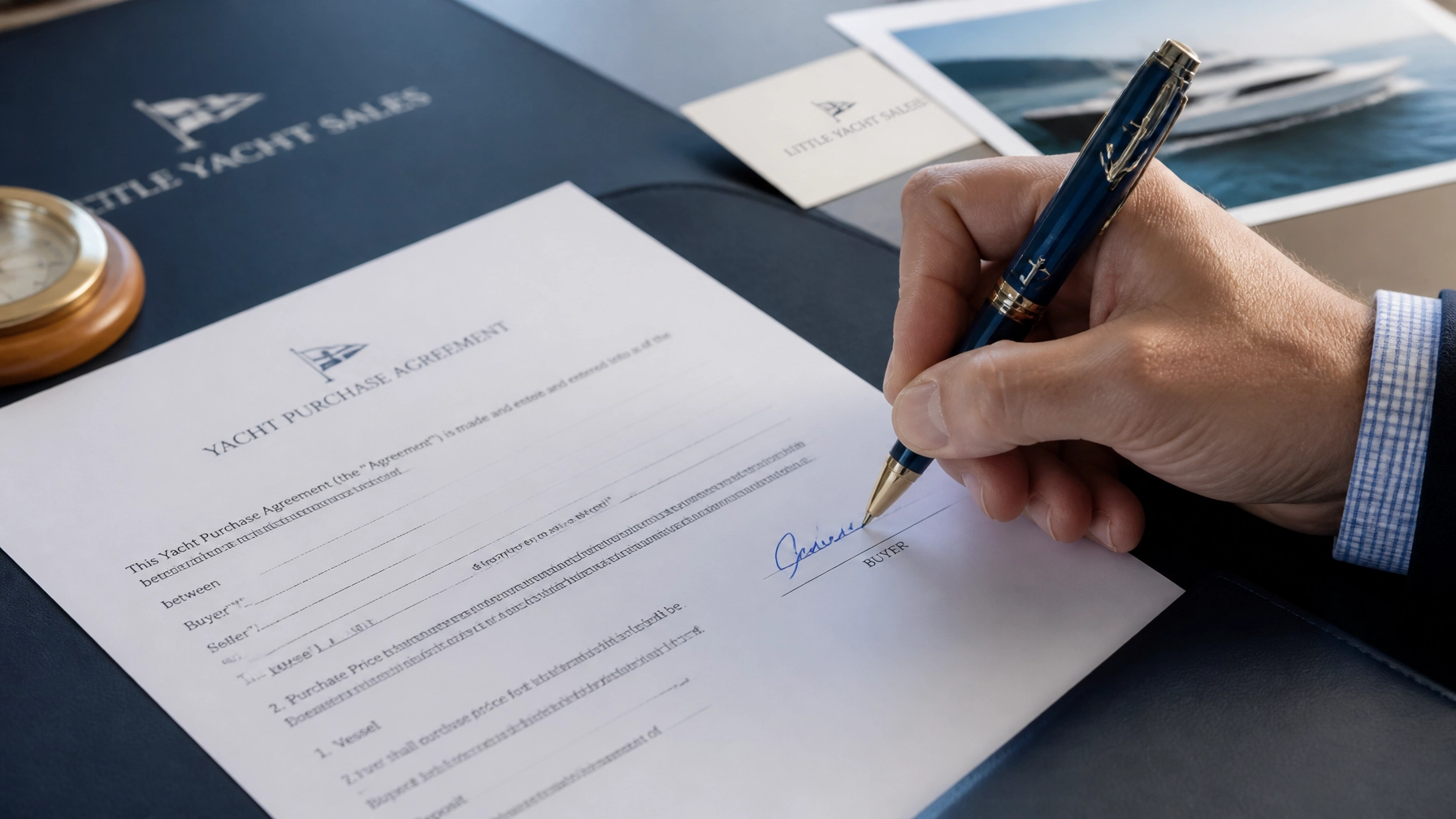
Marine insurance is the second specialized professional service involved in closing the transaction. Like marine financing, it benefits from working with an agent who specializes in yacht coverage rather than a generalist.
A standard yacht insurance policy typically combines two principal coverages: hull coverage, which protects the vessel itself, and liability coverage, which protects the owner in the event of damage to others or to other property. Both are usually bundled into a single policy.
A few terms worth understanding when reviewing a quote:
Agreed value vs. actual cash value. Agreed value coverage pays a pre-agreed amount in the event of a total loss, regardless of depreciation. Actual cash value coverage pays the depreciated value at the time of loss. Agreed value is the stronger structure for most yacht owners and is the standard offered by most reputable marine insurers.
Navigation limits. Every policy defines the geographic area within which coverage is in force. Owners who intend to cruise beyond their home region — to the Bahamas, the western Caribbean, or up the Atlantic seaboard — should confirm that their navigation limits accommodate their actual plans, and adjust if needed.
Named storm and seasonal provisions. Policies in the Gulf and South Atlantic regions include standard provisions for named storm season, covering items such as preparation requirements and seasonal coverage limits. These are routine elements of regional coverage and worth reviewing with your agent at the time of binding so you understand how your policy works.
The survey report’s role. The fair market value opinion in the survey report is what most insurers use to bind agreed-value coverage. This is one reason the survey performs double duty: it informs your purchase decision and it underwrites your insurance.
Insurance must be bound — meaning the policy is actually in force, not merely quoted — before closing. Most agents can produce a binder within a day or two once they have the survey report and basic underwriting information in hand.
The Closing
With financing approved, insurance bound, and any post-survey negotiations resolved, the closing itself is, by design, straightforward.
Closings in yacht brokerage are conducted in one of two ways: in person at the brokerage office, or remotely through coordinated document delivery. Remote closings have become increasingly common and work well, particularly when buyer and seller are in different regions.
The principal documents executed at closing include the bill of sale, which transfers ownership from seller to buyer; the closing statement, which details the financial flow of the transaction; documentation or titling paperwork, depending on which path applies; lender documents, if financing is involved; and an acknowledgment of vessel condition and acceptance, confirming the buyer is satisfied with the final state of the vessel.
Funds move through the brokerage escrow account, with the buyer’s payment received in advance of closing and the seller’s net proceeds disbursed at closing. The earnest money deposit is applied against the purchase price. Closing costs in yacht brokerage are modest compared with real estate — typically limited to documentation fees, applicable state taxes, and any lender-required charges.
Many buyers schedule a final walkthrough on the day of closing, particularly when meaningful time has passed between survey and closing. This is reasonable and standard practice.
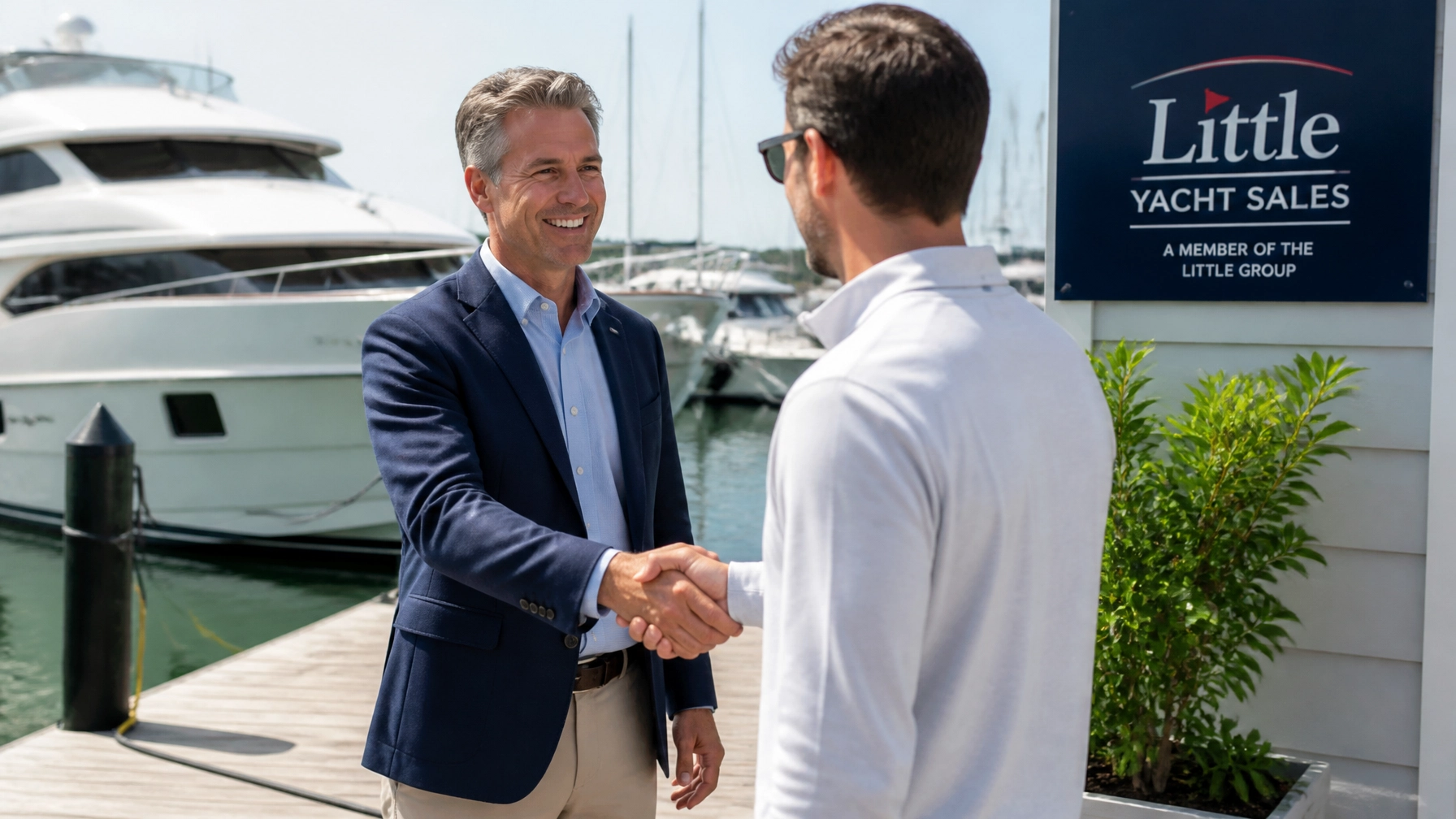
Once the documents are executed and funds are confirmed, the boat is yours.
Documentation: State Titling and Coast Guard Documentation
Every recreational vessel in the United States must be registered under one of two systems: state titling and registration, or federal documentation through the United States Coast Guard. The choice — or, in some cases, the requirement — depends on the boat and the buyer.
State titling and registration is the simpler of the two paths and applies to most smaller vessels. The state issues a title and a registration number, the boat displays state numbers on the bow, and the registration is renewed periodically per state schedule. For most smaller boats, this is the default and the more straightforward option.
Federal documentation is administered by the U.S. Coast Guard National Vessel Documentation Center. Documentation is generally available for vessels measuring five or more net tons — which in practice means most boats from about twenty-seven feet and up — and is required by most lenders for financed vessels of that size. A documented vessel carries a Certificate of Documentation rather than a state title, and its documentation number is permanently affixed inside the hull rather than displayed on the bow. Documentation must be renewed annually.
There are several practical advantages to documentation: a cleaner title structure (federally recognized rather than state-by-state), simplified clearance for international travel, and continued recognition of ownership if the vessel moves between states. Many cruisers and offshore-capable owners opt for documentation even where it is not strictly required.
The transfer of documentation or titling is handled as part of the closing process, generally by the brokerage in coordination with the buyer’s documentation service or attorney. The federal documentation process itself can take several weeks to complete, but this rarely delays the buyer’s use of the boat; the existing documentation or a temporary certificate typically covers the interim period.
A Final Word — and the End of the Series
The closing day on a yacht purchase is, in its own quiet way, a milestone worth marking. You have moved through broker selection, offer and negotiation, survey and sea trial, post-survey resolution, financing, insurance, and documentation — and the result is a vessel that is yours, with the paperwork in order, the insurance in force, and the next chapter of your boating life immediately ahead.
The work of the broker does not end at closing. A good broker remains a resource as you settle into the boat: questions about systems, recommendations for trusted local service providers, introductions at the marina, and — in time — the eventual conversation about what comes next. The relationship that began with an introduction on a listing or a referral to a buyer’s broker tends, in the best cases, to extend across years and across more than one boat.
Little Yacht Sales has guided buyers and sellers through this process for decades, with a team whose combined experience exceeds 150 years on the Gulf Coast and beyond. Whether you are in the early stages of considering a purchase, working through a specific transaction, or thinking ahead to a future boat, our brokers are happy to sit down for a friendly, no-pressure conversation at our Kemah or Key West offices — or right on the docks, where the coffee is always on.
Thank you for following the series. We look forward to seeing you on the water.